
When the July heat settles over Malta, and everyone is looking for a spot to escape the midday sun, the island’s food scene shifts into a completely different gear. Tourists are crowding the streets, outdoor terraces are buzzing, and the craving for something genuinely satisfying takes over. But when you want a break from ordinary meals and standard tourist fare, you start looking for substantial food made with a real respect for process. That is where a master-level Neapolitan pizza technique completely changes the game.
At Grana, we don’t look at pizza as just another menu item. To us, it is a craft built on patience, physics, and a strict adherence to tradition. If you have ever wondered why a true Neapolitan pie tastes and feels entirely different from anything else, the secret isn’t hidden in the toppings. It all starts deep in the kitchen, long before the dough ever touches the peel. You can get a feel for our overall approach to food by exploring our Grana Cucina background.
The Foundation: Why Dough Fermentation is Everything
Ask any seasoned pizzaiolo what separates a memorable pie from a forgettable one, and they won’t talk about cheese or sauce. They will point straight to the dough.
If you’ve ever eaten a heavy slice that left you feeling sluggish and bloated for hours, chances are the dough was rushed. Commercial kitchens often use high amounts of commercial yeast and shortcut rising times to get dough ready in a couple of hours. But when you are aiming to create authentic pizza dough in Malta, locals and food lovers actually appreciate, shortcuts simply don’t work.
Neapolitan dough relies on biological time.
- The Low-Yeast Rule: We use only a tiny fraction of yeast, forcing the mixture to take its time rather than rushing the fermentation.
- Enzyme Activity: Over a long, cold fermentation window (often 24 to 48 hours), natural enzymes break down complex starches and proteins. This process essentially pre-digests the flour, making it remarkably light and easy on the stomach.
- Hydration Mastery: Controlling the exact ratio of water to flour creates a high-hydration dough that retains moisture and builds a complex, subtly nutty flavour profile.
This patient science is why you can finish an entire Neapolitan pizza and still feel light enough to enjoy a walk by the Mediterranean afterwards.
The Core Technique & Craft: Hand-Stretched, Not Rolled
Once the fermentation has worked its magic, the dough is ready for shaping. This is the exact moment where industrial shortcuts fail.
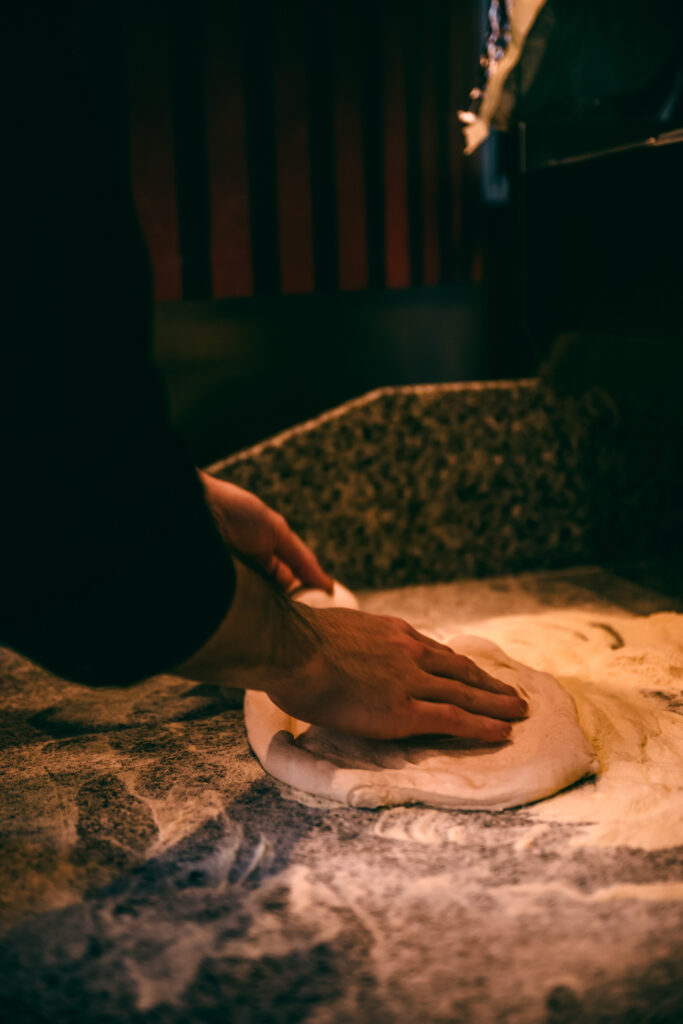
If you walk past our kitchen prep station, you will never see a rolling pin. Rolling pins are the enemy of true Neapolitan pizza. When you press a rolling pin onto fermented dough, you crush the delicate gas bubbles trapped inside by the yeast and natural fermentation. You squeeze out every pocket of air, resulting in a flat, dense, cracker-like crust.
Instead, the process relies entirely on human hands and tactile memory:
- The Air Push: The pizzaiolo uses only their fingertips, gently pressing outward from the centre of the dough ball to push the gas pockets toward the perimeter, creating a natural barrier that will become the crust.
- The Knuckle Stretch: Through smooth, rhythmic movements, the dough is lifted and stretched across the hands, ensuring uniform thickness without losing its internal structure.
- The Texture Contrast: The centre ends up paper-thin and delicate, while the outer rim remains puffy, airy, and cloud-like.
Pairing these handcrafted pies with a refreshing drink or a starter from our kitchen is part of the complete experience. You can check out our full selection on the Menus page.
The Extreme Heat Factor: Capturing Lightning in a Bottle
You can spend days perfecting your fermentation and master the hand-stretching technique down to a science, but without the right oven, the process falls flat. The defining marker of a traditional Italian pizza is its bake, a brief, violent encounter with extreme heat.
Unlike standard home ovens or commercial deck ovens that bake at moderate temperatures for 10 to 15 minutes, a genuine Neapolitan oven operates at a blistering 450°C to 500°C (850°F to 900°F).
At this temperature, the physics of baking change entirely:
- The 90-Second Window: The pizza cooks in roughly 60 to 90 seconds.
- Steam Expansion: The intense heat instantly vaporises the water trapped inside the high-hydration dough, causing the crust to puff up dramatically and bubble.
- Leopard Spotting: The flame-kissed edges develop charred dark spots known as leoparding which add a subtle, smoky bitterness that cuts right through the rich, sweet acidity of San Marzano tomatoes and fresh mozzarella.
This flash-bake locks in moisture, leaving the toppings juicy and fresh while giving the crust a texture that is simultaneously crisp, chewy, and tender.
Frequently Asked Questions:
What makes Neapolitan-style pizza different from other pizza styles?
Neapolitan-style pizza stands apart due to its uncompromising focus on simple ingredients, precise handling, and a rapid, high-heat bake. The core differences include using unadulterated Tipo 00 flour, a long 24-to-48-hour fermentation process for high digestibility, hand-stretching without a rolling pin to protect internal air bubbles, and a 90-second bake in a wood-fired or stone oven to create a soft, blistered crust.
Why is long dough fermentation important for authentic pizza?
Long fermentation gives natural enzymes enough time to break down complex carbohydrates and proteins. This biological breakdown not only develops deep, nutty flavours in the dough but also pre-digests the starches, ensuring the pizza is light, digestible, and doesn’t leave you feeling bloated.
Can you use a rolling pin to stretch Neapolitan pizza dough?
No. Traditional Neapolitan pizza makers strictly avoid rolling pins because they flatten the dough and push out all the valuable air bubbles created during fermentation. Hand-stretching is required to push the air outward into the rim, creating the characteristic raised and airy cornicione.
What temperature do authentic Neapolitan pizza ovens reach?
True Neapolitan ovens reach extreme temperatures between 450°C and 500°C (850°F to 900°F). This allows the pizza to cook in just 60 to 90 seconds, vaporising internal moisture to achieve a texture that is crisp on the outside yet soft and pliable in the middle.
Where can I experience authentic Italian pizza in Malta?
If you want to taste traditional Italian gastronomy crafted with genuine technique, you can visit us at Grana. We bring the authentic culinary spirit of Italy to the island, serving up handcrafted Neapolitan pizzas alongside a full menu of fresh dishes. Take a look at our offerings on our menus page or learn more about our kitchen philosophy on our Grana Cucina page.
Taste the Tradition at Grana
Reading about the science of fermentation and the magic of a 90-second wood-fired bake is one thing, but experiencing the texture and flavour firsthand is entirely different.
If you are exploring the island and want to sit down for a meal where real craft matters, we are ready for you. Take a quick look at our Menus to see what’s coming out of our oven today, and come taste the difference proper technique makes.